


Tower of hanoi
1. Problem Explanation
The Tower of Hanoi is a classic recursive problem.
You are given:
- Three pegs:
A(source),B(auxiliary),C(destination) - n disks of different sizes placed on peg
A - Larger disk cannot be placed on smaller disk
- Move all disks from peg A → C, using peg B as helper
2. Rules
- Only one disk can be moved at a time.
- A disk can be placed only on an empty peg or on a larger disk.
- Use peg B as auxiliary.
3. Recursive Idea
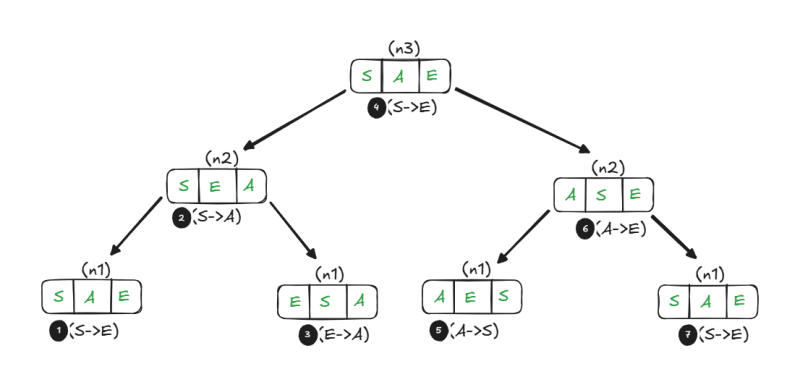
To move n disks from A → C:
- Move
n-1disks fromA → B(using C) - Move last disk (
nth) fromA → C - Move
n-1disks fromB → C(using A)
Figure: Recursion Tree for Tower of Hanoi (n = 3)

4. Recurrence Relation
Base case:
Solution of recurrence:
5. Algorithm
bash
TOH(n, source, auxiliary, destination):

    if n == 1:
        print("Move disk 1 from", source, "to", destination)
        return

    TOH(n-1, source, destination, auxiliary)

    print("Move disk", n, "from", source, "to", destination)

    TOH(n-1, auxiliary, source, destination)
6. Time Complexity
So the time complexity is:
Exponential — O(2ⁿ)
7. Space Complexity
Recursion depth is n:
8. Example (n = 3)
Sequence of moves:
A → CA → BC → BA → CB → AB → CA → C
Total moves: