


Recurrent Neural Network (RNN)
A Recurrent Neural Network (RNN) is a type of neural network designed to handle sequential data. Unlike traditional feed-forward networks, RNNs use connections that form cycles, allowing them to maintain a "memory" of previous inputs. This makes them suitable for tasks where the current output depends on previous steps (e.g., predicting the next word in a sentence).
How RNN Works

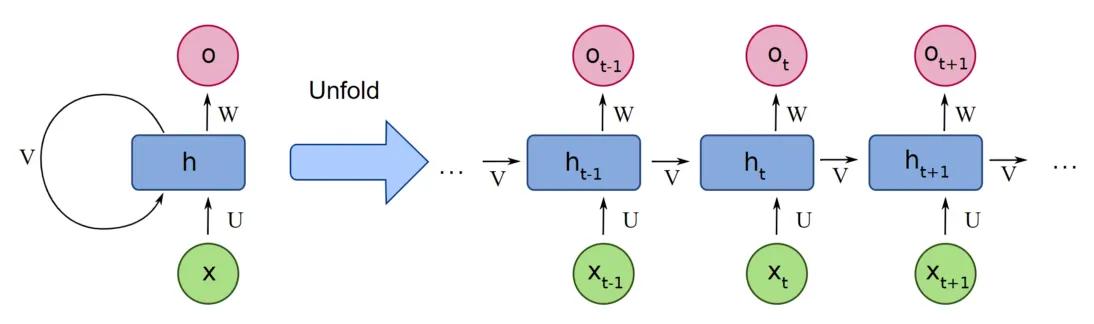
- Input vector is passed into the hidden layer at each time step .
- The hidden state is calculated using both the current input and the previous hidden state .
- The output is generated from the hidden state.
- At the final time step, the last hidden state can be used to calculate the overall output.
- Errors are backpropagated through time (BPTT – Backpropagation Through Time) to update the weights.
Why RNN is Needed
- Feed-forward networks cannot handle sequential data as they only consider the current input.
- They cannot memorize past inputs/outputs.
- RNNs solve this by retaining information through hidden states, making them effective for sequential tasks like speech, text, and time-series prediction.
Types of RNN

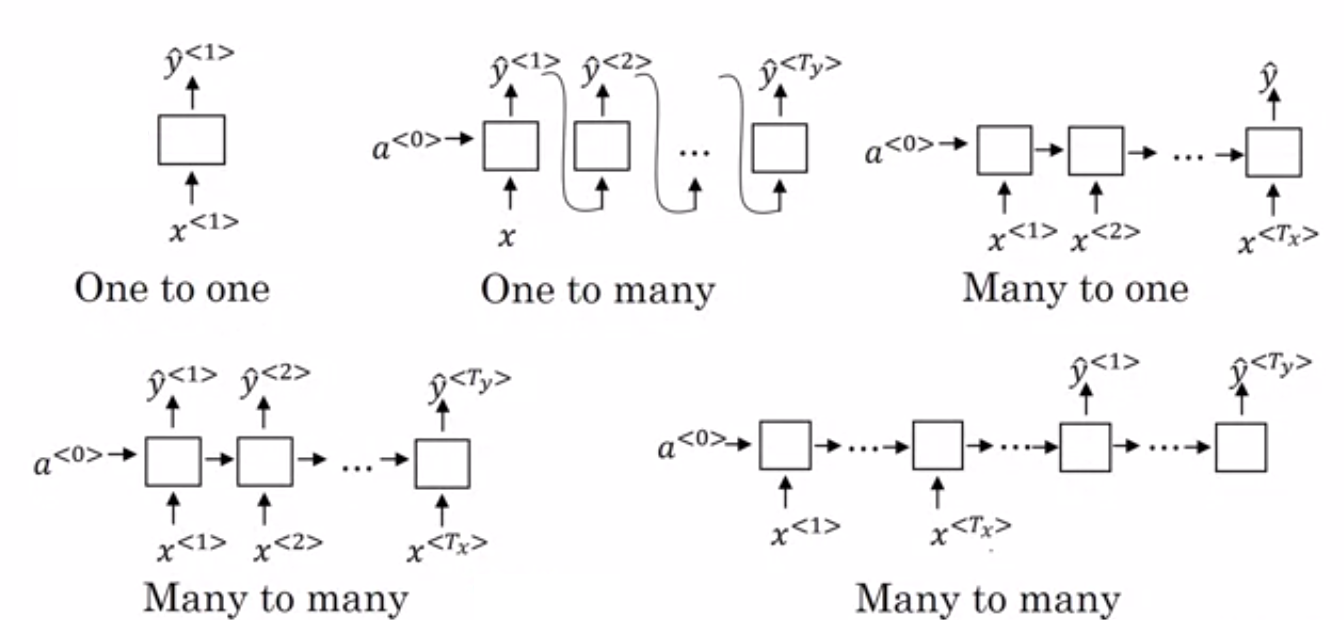
- One-to-One → Simple input → output mapping (e.g., image classification).
- One-to-Many → Single input, multiple outputs (e.g., image captioning).
- Many-to-One → Multiple inputs, single output (e.g., sentiment analysis).
- Many-to-Many → Multiple inputs and outputs (e.g., machine translation, video processing).
Advantages of RNN
- Sequential memory: Retains information from previous inputs.
- Time-series prediction: Past data helps predict future values.
- Combination with CNNs: Can be used with convolutional layers to capture spatial + sequential features (useful in video and image tasks).
Limitations of RNN
- Vanishing gradient problem: Gradients shrink during backpropagation, making it hard to learn long-term dependencies.
- Exploding gradient problem: Gradients grow too large, causing unstable training.
- Slow training: Sequential nature limits parallelization compared to CNNs/Transformers.
Applications of RNN
- Speech recognition
- Time-series prediction
- Natural Language Processing (NLP):
- Language modeling
- Sentiment analysis
- Machine translation
- Image & video processing