


(MST) Kruskal’s & Prim's Algorithm
1. Objective
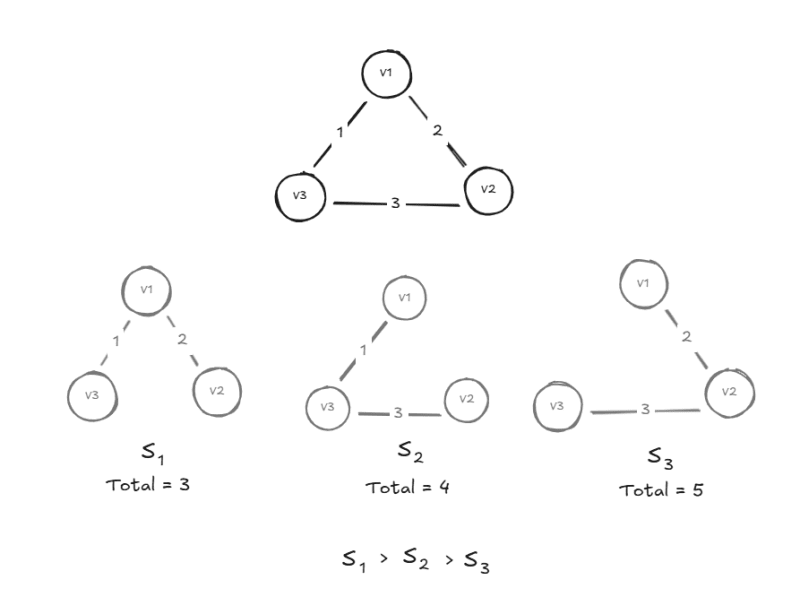
Kruskal’s Algorithm finds a Minimum Spanning Tree (MST) of a connected, weighted graph by selecting the smallest edges first while avoiding cycles.

2. Key Points
- Uses Greedy Strategy.
- Works well for sparse and large graphs.
- Operates on edges, not adjacency lists.
- Requires a Disjoint Set / Union-Find data structure to detect cycles efficiently.
3. Inputs
- V → Number of vertices
- E → Number of edges
- Spanning tree always contains V − 1 edges
4. Steps of the Algorithm
- Sort all edges in non-decreasing order of weight:
- $
- Initialize MST = Ø (empty set)
- For each edge (u, v) in sorted order:
- If adding the edge does NOT form a cycle → add it to MST
- Otherwise → skip the edge
- Use Union-Find to check cycle
- Stop when MST contains V − 1 edges
5. Output
- Set of edges forming the Minimum Spanning Tree
- MST total weight is minimum possible
6. Time Complexity
Dominant step → Sorting edges
World of defense on sorting algorithm which we use to sort the edge set E
- Sorting edges:
- Union-Find operations: O(E α(V)) ≈ O(E)
(α = inverse Ackermann, extremely slow-growing)
✔ Final complexity:
7. Example Use-Cases
- Network design (cables, LAN)
- Road/rail route optimization
- Clustering in ML
- Minimum-cost spanning infrastructure
8. Pseudocode
powershell
Kruskal(G):
  sort edges by weight
  initialize MST = empty set
  make-set(v) for each vertex v

  for each edge (u, v) in sorted order:
    if find(u) != find(v):
       add (u, v) to MST
       union(u, v)

  return MST