

MiniMax Using Divide & Conquer
Idea
MiniMax is a decision-making algorithm used in adversarial search (like games).
Using divide and conquer, we recursively split the game tree into two subproblems:
- Left subtree → Maximizer’s choice
- Right subtree → Minimizer’s choice
At each level:
- Max level: choose max(left, right)
- Min level: choose min(left, right)
The game tree is divided into two equal halves until we hit leaf nodes.
Procedure
cpp
int minimax(int arr[], int l, int r, bool isMax) {
    // Base case: when only 1 or 2 elements left
    if (r - l + 1 <= 2) {
        if (isMax) return max(arr[l], arr[r]);
        else return min(arr[l], arr[r]);
    }

    int mid = (l + r) / 2;

    // Divide into two equal problems
    int left  = minimax(arr, l, mid, isMax == false);
    int right = minimax(arr, mid + 1, r, isMax == false);

    // Combine result depending on Max or Min level
    if (isMax) return max(left, right);
    else return min(left, right);
}
Divide & Conquer Recurrence
Given:
This simplifies to:
Time Complexity

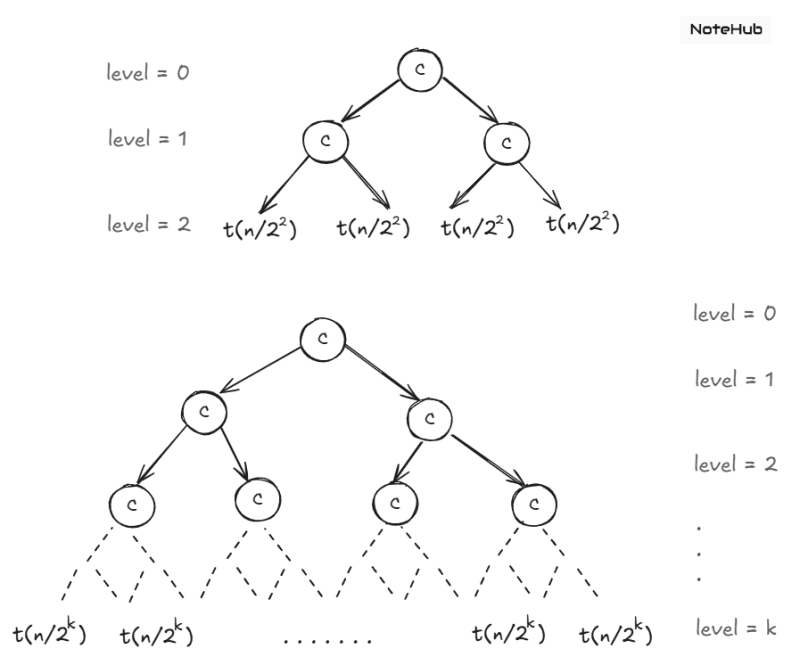
Taking :
The inside term is a geometric progression:
This is GP with:
- first term
- common ratio
- number of terms
GP Sum Formula
For
Asymptotically:
Final Time Complexity
✔
✔ You process all leaf nodes once
✔ Divide & Conquer halves the problem but doubles calls → linear overall