


Merge Sort
Merge Sort is a Divide and Conquer algorithm.
- Given an array
a[1…N], merge sort works as follows:- Divide the array into two equal halves.
- Recursively apply merge sort to both halves.
- Use the merge operation to combine the two sorted halves into one sorted array.

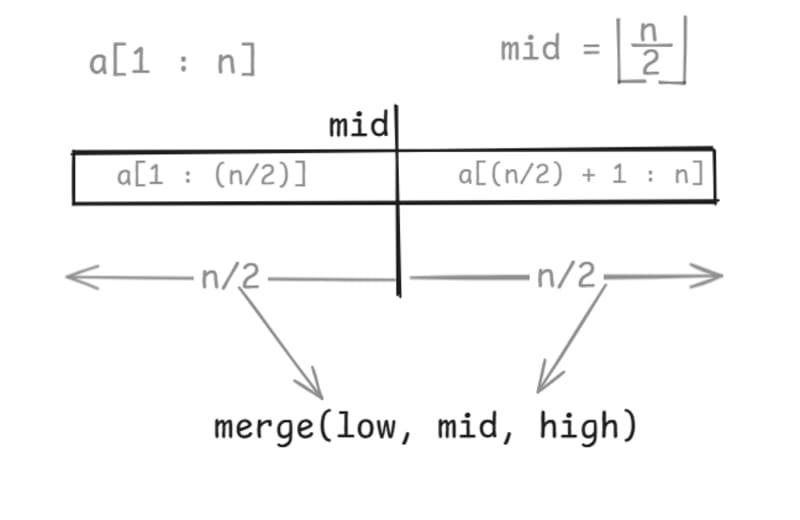
Algorithm (Merge Sort)
vbnet
MERGE_SORT(low, high)
1. if low < high
2.     mid = (low + high) / 2
3.     MERGE_SORT(low, mid)
4.     MERGE_SORT(mid + 1, high)
5.     MERGE(low, mid, high)
Merge Operation
a[low…high]is a global array, wherea[low…mid]anda[mid+1…high]are the sorted subarrays residing within it.MERGE(low, mid, high)will merge these sorted subarrays into a single sorted arrayb[]is an auxiliary array used for merging.
c
i = low
j = mid + 1
h = low
while(n ≤ mid && j ≤ high) do
{
    if(a[h] ≤ a[j]){
        b[i] = a[h++]
    }
    else{
        b[i] = a[j++]
    }
    i = i + 1
}

// left subarray exhausted
if(h > mid){
    for k = j to high do
    {
        b[i] = a[k]
        i = i + 1;
    }
}

// right subarray exhausted
if(h > mid){
    for k = h to mid do
    {
        b[i] = a[k]
        i = i + 1;
    }
}

// copy the auxillary array b to main array
for k = low to high do
{
    a[k] = b[k]
}
Time Complexity of the Merge Operation
When merging two sorted subarrays, each of size n/2:
- Minimum Comparisons:
- Occurs when every element of the first subarray is less than or equal to every element of the second subarray (or vice versa).
- In this case, only n/2 comparisons are required.
- Maximum Comparisons:
- Occurs when elements are compared alternately from both subarrays until one subarray is exhausted, leaving exactly one element in the other subarray.
- In this case, up to n – 1 comparisons are required.
Merge Sort Recurrence Relation
- Let T(n) = time taken by merge sort to sort array
a[1…n]. - Computing the mid index takes constant time →
c₁. - Dividing into two halves:
- Each half has size
n/2. - Recursive calls take
2T(n/2).
- Each half has size
- Merging two sorted halves takes O(n) time →
c₂n.
🔹 Recurrence Relation for Merge Sort
Base case:
Simplified Form
Since constants don’t matter in asymptotic notation:
2T(n/2)→ recursive cost of sorting two halvesDn→ merging costc₁→ cost of computing mid (constant)
So,
Limit Test for
Define:
Now,
Hence,
So recurrence reduces to:
Recursive Tree

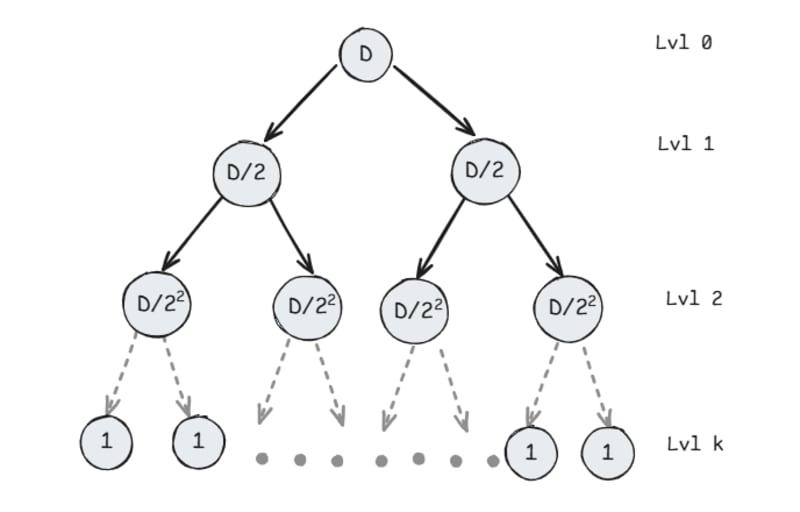
Recursive Tree Expansion
- Level 0 →
- Level 1 →
- Level 2 →
- …
- Level →
- Leaves →
- is the number of internal levels of the tree,
- is the total non-recursive work per level (e.g ),
- is the number of leaves and is the cost at a leaf.
Since and
Asymptotic Analysis
So,
Therefore: