


LSTM (Long Short-Term Memory)
LSTM is a special type of recurrent neural network designed to efficiently learn and retain long-term dependencies in sequential data. Traditional RNNs struggle with the vanishing and exploding gradient problem. LSTM overcomes this limitation by introducing a unique memory-cell structure that selectively writes or forgets information as needed.
The core components of LSTM lie in its gating system: the forget gate, the input gate, and the output gate. These gates regulate the flow of information, enabling the network to focus on reliable data while discarding unnecessary details.
The internal architecture of the LSTM Unit

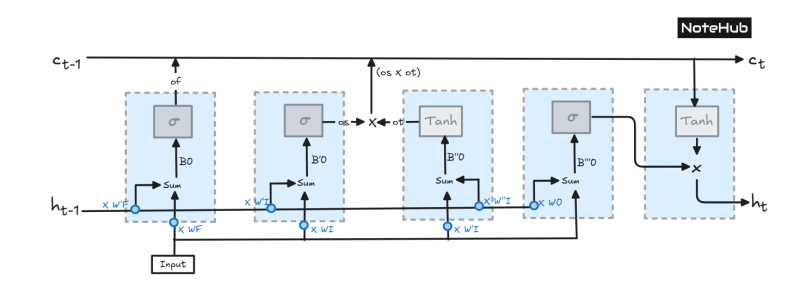
Components
LSTMs use three gates to control how information flows through the network and to manage long-term memory.
1. Forget Gate
- Decides what information from the previous cell state to remove.
- Uses a sigmoid (0–1) to keep (1) or forget (0) information.
2. Input Gate
- Determines what new information to add to the cell state.
- Sigmoid selects which values to update.
- tanh creates candidate new information.
3. Output Gate
- Controls what part of the cell state becomes the output.
- Uses sigmoid to filter the state and tanh to scale the final output.
Summary:
These gates enable LSTMs to remember important information and forget irrelevant details, allowing them to effectively capture long-term dependencies in sequence tasks.
RNN vs LSTM Comparison
| Feature | RNN | LSTM |
| Architecture | Simple structure with hidden state. | Complex structure with cell state and agating mechanism. |
| Gradient Issue | Prone to vanishing and explodinggradients in long sequences. | Mitigates gradient issues using cell state forbetter information flow. |
| Memory Management | Relies only on hidden state, oftenlosing long-term dependencies. | Uses cell states + gates to retain relevantlong-term information. |
| Sequential Handling | Works well for short sequences butstruggles with long ones. | Efficiently handles both short and longsequences. |
| Learning Mechanism | Simple backpropagation through time (BPTT). | Incorporates gate mechanisms (forget, input, output)for flexible learning. |
| Flexibility | Suitable for basic tasks (e.g., sentiment analysis). | Suitable for complex tasks (e.g., machine translation,speech synthesis). |
| Training Stability | Training may become unstable due togradient problems. | Gates ensure stable training even with longsequences. |
Applications of LSTM
- Speech Recognition
LSTM plays a vital role in converting spoken words into text by processing sequential audio data. Their ability to retain long-term dependencies makes them effective in identifying patterns in speech signals, improving the accuracy of automatic speech recognition systems. - Natural Language Processing (NLP)
LSTMs are extensively used in NLP tasks like sentiment analysis, language translation, and text summarization. They capture the context and semantics of words over long sentences, enabling applications like chatbot responses, email sorting, and more. - Forecasting
LSTMs are widely used in analyzing sequential data over time, making them a preferred choice for forecasting trends in finance, marketing, energy consumption, and weather prediction. - Healthcare Data Analysis
LSTMs analyze time-series data such as patient vitals, ECG signals, and medical histories to predict diseases, monitor health conditions, and recommend personalized treatments.