


Ensembling Learning
Definition:
Ensemble learning is a machine learning technique where multiple models are combined to produce a better overall prediction than any single model alone.
Advantages
- Improved Predictive Accuracy:
Combining several models reduces errors and improves overall performance.
Disadvantages
- Low Interpretability:
Ensembles (like Random Forest, Gradient Boosting, Stacking) are often difficult to understand because they merge many models.
Why Ensembles Help
- Statistical Stability:
When the dataset is limited, many different hypotheses (possible models) may fit the data equally well. - A traditional algorithm picks only one hypothesis, which may:
- perform well on training data
- but perform poorly on unseen data
- Ensemble methods reduce this risk by combining many hypotheses.
Key Terms
- Hypothesis:
Any possible model or outcome generated from the data. - Hypothesis Space:
The set of all possible hypotheses a learning algorithm can choose from. - Limitation of Algorithms:
Due to computational constraints, algorithms cannot guarantee finding the absolute best hypothesis in the entire hypothesis space.
Bagging (Bootstrap Aggregating)
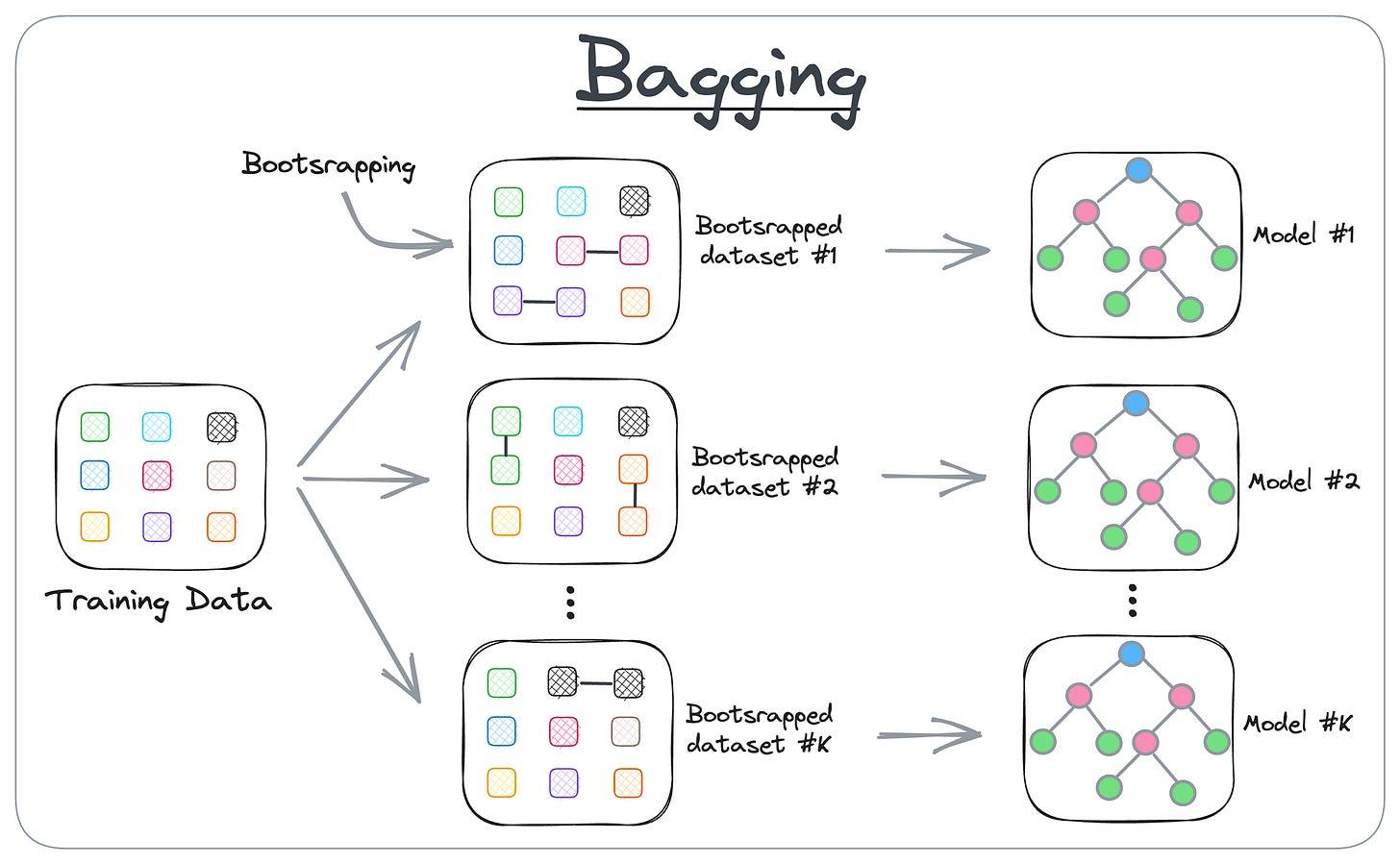
Bagging is a homogeneous weak learner ensemble method where multiple models are trained independently in parallel and their outputs are combined to produce a final prediction.
Example: Random Forest
Benefits of Bagging
- Reduces overfitting
- Improves accuracy
- Handles unstable models (like decision trees)
- Different experiments on the same input may produce different outcomes, increasing diversity
Steps of Bagging
- Create multiple subsets from the original dataset
- Done randomly with replacement (bootstrap sampling)
- Subsets have almost equal size and similar feature values
- Select observations with replacement for each subset
- Train multiple models in parallel, each on a different subset
- Collect predictions form all models
- Combine the predictions
- Classification: Use majority voting
- Regression: Take the average of all model outputs

Boosting
Boosting is an ensemble method in which models are arranged in sequence to create a strong classifier. The process involves building models sequentially, where each model aims to correct the error made by the previous model.
Algorithm of Boosting
- Initialize the dataset
- Assign equal weights to all data points.
- Train the first model
- Identify the wrongly classified data points.
- Update weights
- Increase weights of wrongly classified points
- Decrease weights of correctly classified points power
- Check accuracy
- If the desired accuracy is reached → go to Step 5
- Else → repeat from Step 2
- Stop
- The boosting process ends.
Random Forest
Random Forest is a supervised learning algorithm used for both classification and regression. It works by randomly creating a forest of decision trees, trained in parallel using the bagging technique.
The final prediction is based on:
- Majority Vote → for classification
- Average of Predictions → for regression
Algorithm (Random Forest)
- Bootstrap Sampling
If the training set has examples, randomly select N data points with replacement from the original dataset.
This sample becomes the training set for one decision tree. - Random Feature Selection
If there are input features, choose M features at each node .
The value of remains fixed throughout tree construction. - Prediction of New Data
- Pass the new input through each decision tree.
- Each tree gives its own classification or regression output.
- Combine the outputs using:
- Majority vote (classification)
- Average (regression)
Advantages of Random Forest
- Efficient on large datasets
- Handles a large number of input features without feature deletion
- Provides feature importance estimates
- Deals well with missing data
- Models (forests) can be saved and reused
- Works for both classification and regression
- Helps detect variable interactions
Disadvantages of Random Forest
- For regression, it cannot predict beyond the range of training data
- Large model size (many trees) → more memory usage and slower predictions
- Acts like a black box → difficult to interpret